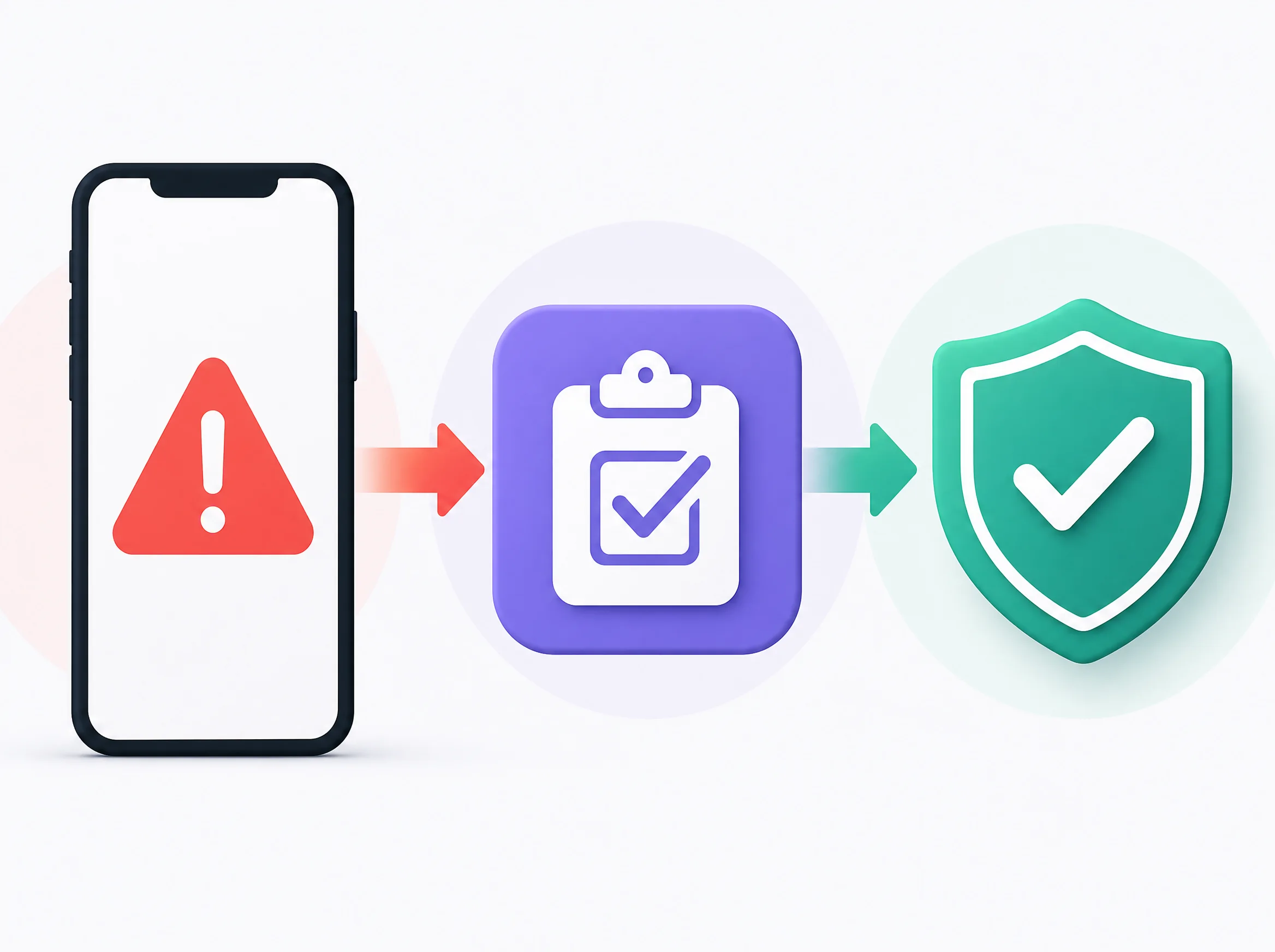
HSE: turning a field photo into a traceable corrective action
A photo shows a problem; it only creates value when it becomes a traceable corrective action — captured, owned, closed with evidence.
A photo taken in the field shows a lot: a missing guardrail, a blocked fire exit, a chemical spill, a worker without PPE. It is useful. But it is rarely enough. Where was the photo taken? When? Who reported it? How serious is it? Who is responsible for fixing it? By when? Was the gap ever closed? And can you show it in an audit? A photo sent over WhatsApp or buried in an email is a risk that was seen — but never captured.
A photo does not speak for itself
To the person who took it, the image is clear: they know where they stood, what they were looking at, why it matters. To everyone else, the same photo is silent. It shows neither the site, nor the area, nor the type of hazard.
What turns a photo into an HSE record is context: the location, the area, the nature of the hazard, the severity, the immediate action taken, the owner, the deadline, and the closure evidence. Without those, the image stays an attachment. With them, it becomes a record you can act on.
The report that gets put off
Reporting properly is heavy. You open a form, pick a category, describe the situation, upload the photo, specify the area. On the floor, between two tasks, nobody has the time. So people take the photo and tell themselves they will report it later.
But later becomes forgotten. The result: teams see far more risks than they formally report. The gap between what is observed and what is recorded is not a problem of diligence — it is a problem of friction.
Severity that depends on who is looking
One supervisor calls a hazard medium. Another, facing the same situation, calls it high. Without a shared reference, severity becomes a matter of individual judgement. And when severity is inconsistent, corrective actions are no longer prioritised correctly: the serious waits while the minor gets handled.
AI can suggest a severity level from the photo and its context. But it does not decide it. The HSE manager validates, adjusts, rules. The suggestion speeds things up; the decision stays human.
Without an owner, the action drifts
An observation with no owner does not get fixed. Maintenance assumes it belongs to operations. Operations assumes it belongs to HSE. Everyone waits for someone else, and the gap stays open. An action needs a name, not a department.
Closure, in turn, should require evidence — a photo after the correction — not just a status change. Fixed without an image is a claim. A photo of the cleared aisle, the fitted guardrail, the worn PPE is proof. That difference matters on audit day.
Nothing to show the auditor
HSE work has to be demonstrated — to an auditor, to a client, to a principal. The question is not only whether you fixed it, but whether you can prove what was reported, reviewed, assigned and closed.
When the evidence is scattered across photos on phones, chat messages and three spreadsheets, reconstructing that history is painful — and sometimes impossible. An audit trail is not administrative luxury: it is what separates an HSE system from a collection of good intentions.
From photo to structured observation
The point is not to replace the human, but to remove the friction. An HSE assistant helps the field team upload a photo and add the minimum of context. From there, it suggests a hazard category and a possible severity, then drafts a structured observation and a first corrective action.
Then the HSE manager takes over: they check the severity, name the owner, set the deadline and validate closure against evidence. The machine structures; the human decides. It is that split of roles that makes the system both fast and reliable.
Where BeLogic fits
Our HSE agent, Sentinel, helps turn field observations into structured, traceable corrective actions — from reporting to closure with evidence. It captures the context, suggests a category and a severity, and prepares an audit-ready record.
But it does not decide for the HSE manager: severity, ownership and validation remain their responsibility. Hosted in Europe and built around GDPR compliance, Sentinel fits your real processes — not the other way round. A photo is only the beginning. The value comes when it becomes an action.