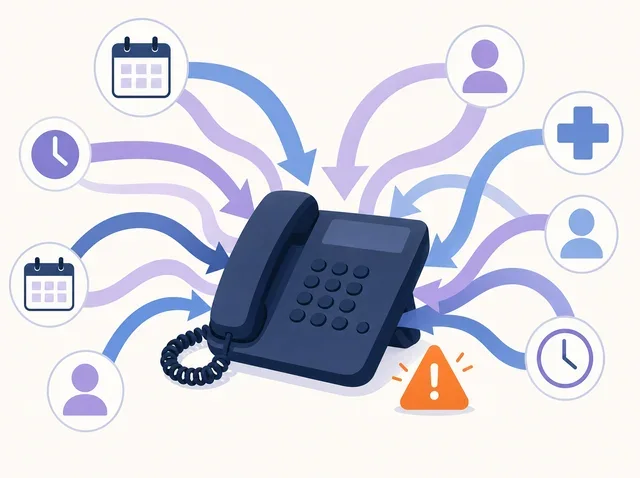
Medical Practices: Why the Front-Desk Phone Has Become an Operational Risk
For a medical practice, the front-desk phone is the first point of care — and when it overloads, it becomes a risk.
The ideal is simple: a patient calls, someone answers, the appointment is booked, the question is resolved. Reality is less tidy. The line is busy, the call lands during the lunch break, one patient wants to reschedule, another asks for test results, a third is worried about a symptom. Nobody answers, so they call back — then call another practice. The phone, meant to be a doorway, has become a bottleneck. For many practices this isn't a comfort detail: it's the exact point where access to care is won or lost.
The phone is the first point of care
For a patient, calling the practice isn't an administrative task — it's how they access care. They experience that first contact as the start of being looked after, not as front-desk work. So the quality of that exchange matters as much as what follows: a patient who gets a clear, quick answer feels cared for, even before seeing the doctor.
Conversely, a saturated line sends an unintended message — that of a practice that is hard to reach. This isn't only about image. It's about continuity: a missed appointment, an untransmitted result, a concern that goes unheard all carry real consequences.
Missed calls are costly
A missed call is never neutral. Staff are already on another line, the office is closed, several patients ring at once. Every unanswered ring is a request that vanishes: a cancellation that would have freed a slot, a new patient who would have filled the diary, a simple question that becomes a bigger problem later.
These losses are invisible because they leave no trace. You can't measure the patients who never got through. Yet it's lost work — and, worse, lost trust. The patient who gets no answer doesn't always complain; they simply move to another practice.
A front desk that does far more than answer
Reception staff do more than pick up the phone. They welcome the patients who are physically present, prepare files, handle payments, coordinate with doctors, process the post. In that context, every ring interrupts a task in progress. And interruption has a cost: it breaks focus, increases mistakes, turns an organised day into a constant scramble.
The problem isn't the staff, who often do remarkable work under difficult conditions. The problem is the operating model: asking one person to manage, simultaneously, the counter and an unpredictable stream of calls. No organisation holds that up for long without a drop in quality.
Repeated administrative questions
A large share of calls concern simple, recurring questions. What time is my appointment? Are you open this afternoon? Do I need to bring a document or a prescription? These questions are legitimate and important to the patient, but they consume a considerable amount of time relative to their content.
Each answer is quick in isolation; multiplied across the day, it takes up a real portion of front-desk time — time that is no longer available for the patients present or for the requests that genuinely need human judgment.
Unclear urgency and incomplete messages
Not all calls are equal, and that is where the risk concentrates. A genuinely worried patient may sound calm; another may dramatise something minor. Knowing when to escalate, and to whom, requires clear rules — not case-by-case improvisation.
On top of this sits the fragility of relayed messages. A verbal note or a slip of paper left on a desk loses detail: the exact reason, the callback number, the degree of urgency. Incomplete information creates rework, unnecessary callbacks and, sometimes, sensitive requests that slip through the cracks.
Where an AI voice assistant genuinely helps
An AI voice assistant is not there to replace medical judgment — that is not its purpose. Its role is administrative and about routing: answering when staff can't, identifying the reason for the call, handling simple questions (hours, address, documents to bring), capturing an appointment or cancellation request, and cleanly summarising each message for the team.
Above all, it works within a clear boundary. It gives no medical advice. Faced with a situation that falls outside the administrative frame or that seems urgent, it doesn't decide: it collects the essential information, flags it as possibly urgent and hands it to a human for the decision. The patient is always routed to a person when needed.
Where BeLogic fits
At BeLogic, we design medical voice assistants around the real front-desk workflow, not a theoretical script. We define what the assistant handles itself, what it escalates to the team, which information it collects, where the summaries go, and how patient data is protected — EU hosting and GDPR compliance as the starting point, not an option. Medical judgment stays entirely in human hands; the assistant takes on the administrative load that currently stops the front desk from doing its real job. For a practice, the goal isn't to automate patient contact, but to guarantee that no patient is left without an answer — and that every sensitive case reaches the right person, in time.