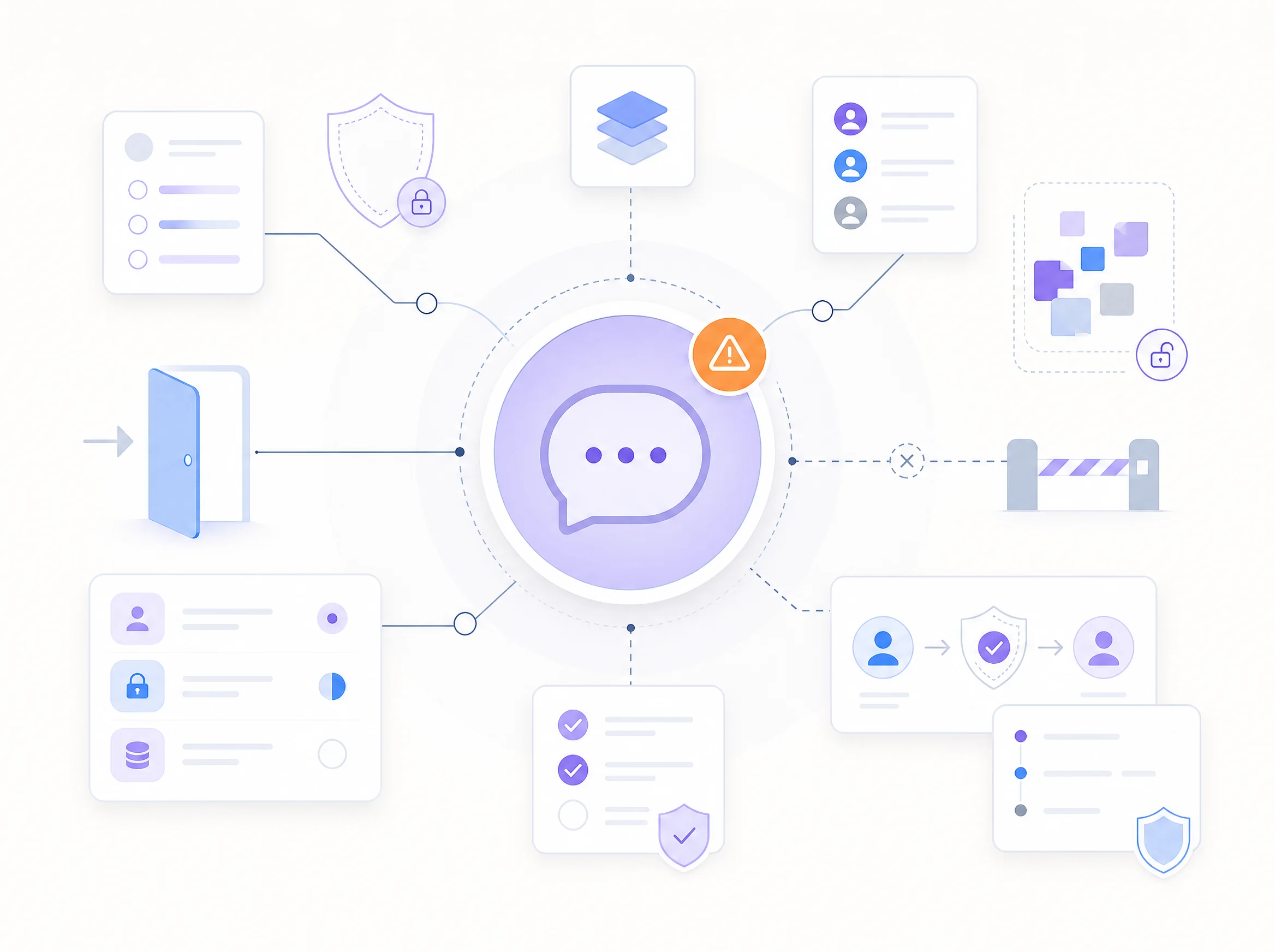
Why an Internal AI Assistant Without Governance Quickly Becomes Risky
An internal AI assistant sounds harmless. That is exactly where the risk begins.
Employees ask questions, the assistant searches company documents, summarises information and drafts answers. It saves time and makes knowledge easier to access — and in many companies that promise is real. But the same assistant that makes information easier to find can also make sensitive information easier to expose; the one that helps employees move faster can also spread wrong answers faster. That is why an internal AI assistant should not be deployed like a simple productivity tool: it becomes part of how the company accesses knowledge, which means it needs rules.
The assistant sees too much
Many internal assistants are connected to shared drives, CRMs, HR folders, client folders, financial documents and legal templates. That creates value — and danger. If the assistant can access everything, a junior employee might ask about salaries and receive HR data; a salesperson might receive confidential legal notes; a consultant might see another client's information. The assistant does not understand internal confidentiality by default — it follows permissions and data connections. If those are poorly configured, it becomes a shortcut around company boundaries. An internal assistant must respect existing permissions: employees should only receive answers from information they are allowed to access. If that cannot be guaranteed, deployment should wait.
Outdated information and false confidence
Companies have many versions of the same document — old policies, drafts, duplicates. When humans search manually they may pick the wrong file; an AI assistant can make it worse by combining sources and presenting the answer confidently. The employee may not realise it is based on outdated material. And AI answers often sound polished, which is a problem: clarity does not guarantee correctness. The assistant can misunderstand a question, miss context or answer from incomplete sources while sounding official. Governance should require approved sources and define how confidence is handled: the assistant should show sources, flag uncertainty, say when information is missing, avoid answering outside approved sources, and make clear when human review is needed.
Blurred responsibility and sensitive prompts
When an employee uses an assistant, who is responsible for the answer — the employee, the manager, IT, the provider? AI should never become an excuse for unclear responsibility. Governance should assign roles: a business owner, a technical owner, a data owner, and a review process for errors (in an SME, one person may hold several). Governance is also about what employees type in: people may paste client data, CVs, medical notes or contracts into prompts without thinking. The company should understand whether prompts and uploads are stored, used for training or reviewed by humans, and give clear usage rules — do not paste passwords, do not upload unapproved personal data, do not use the assistant for final decisions.
Shadow AI
If the company provides no clear AI governance, employees create their own solutions: public tools, personal accounts, browser extensions, confidential information copied into external systems. This is shadow AI, and it happens when people want speed but have no approved tools or rules. Trying to ban everything rarely works — people still need help. A better approach is to provide approved AI tools with clear boundaries: which tools are allowed, which data can be used, which tasks are approved or forbidden, who to ask when unsure, and how to request new use cases. Governance should reduce unsafe improvisation by giving employees a safe path.
Limits, logs and training
An internal assistant should have limits — questions it should refuse or escalate: confidential information outside the user's role, individual salaries, medical or legal advice outside scope, instructions to bypass policy. A safe assistant does not try to answer everything; when a request crosses a boundary, it stops, explains briefly and points to the right process. It also needs logs (who asked, what data was used, what answer was given) — useful for security, quality and compliance, but logs themselves need governance because they may contain sensitive information. Finally, employees need training on what the assistant is for, which sources it uses, what data not to upload, and how to check answers — otherwise some trust it too much and others ignore it completely.
What good governance looks like
Governance does not need to be complicated at the start. For an SME, a simple framework on a few pages can be enough — answering: purpose (what is the assistant for), scope (which teams, workflows and documents), data (which sources are approved), access (who can use it and see what), limits (what is forbidden), human review (which outputs require checking), security (how prompts, uploads, logs and permissions are handled), ownership (who is responsible) and monitoring (how quality, usage, errors and costs are reviewed). The point is clarity: employees should know how to use the assistant safely, managers how it is controlled, and leadership who owns the risk.
Where BeLogic fits
At BeLogic, we believe internal AI assistants should be useful, secure and governed from the beginning. We help design assistants around real workflows and approved knowledge sources — defining what the assistant can access, who can use it, which outputs require human review, how sources are managed, and how the system should behave when uncertain. For SMEs, this can mean an internal knowledge assistant for policies, a recruitment assistant for CV summaries, an HSE assistant for observations, a legal knowledge assistant for document search, or an accounting assistant for client files. An internal AI assistant can become one of the most useful tools in a company — it can also become risky if nobody defines the rules. The difference starts with governance: it should make knowledge easier to use, not make risk harder to see.